Wednesday, March 07, 2007

Meeting Recap: Dirt cheap design done right

Magazine designers and editors want first rights on the use of high-resolution photographs. Obtaining the photographs for little or no charge ranks as another high priority, especially since business-to-business publications tend to have limited design budgets.

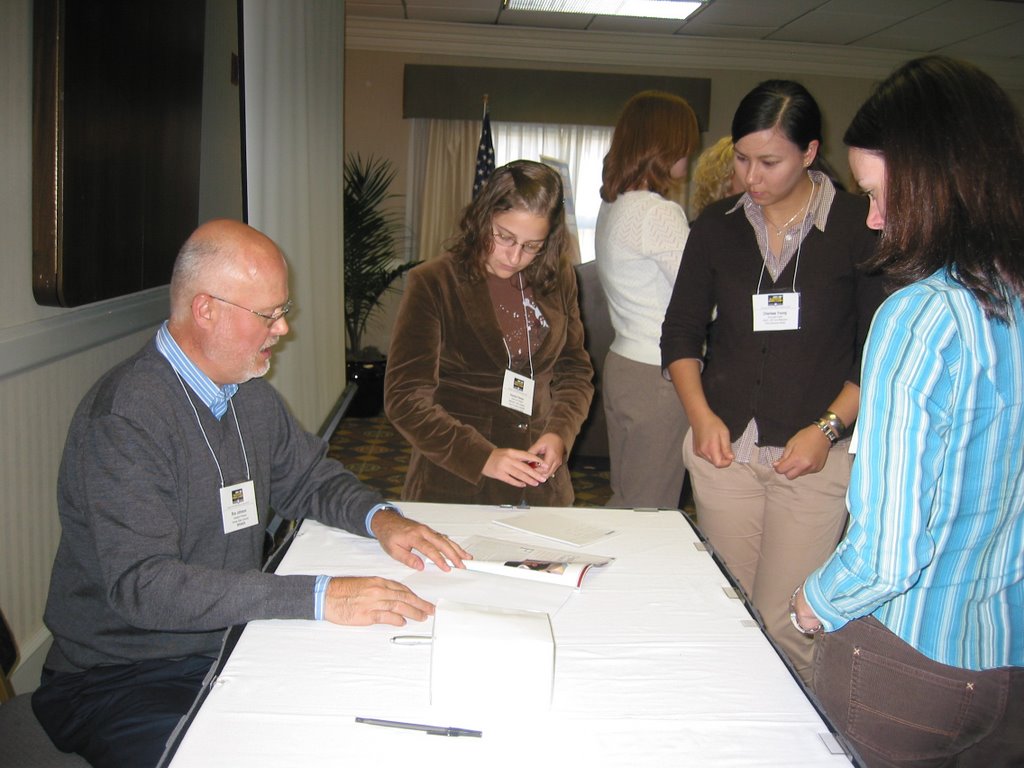
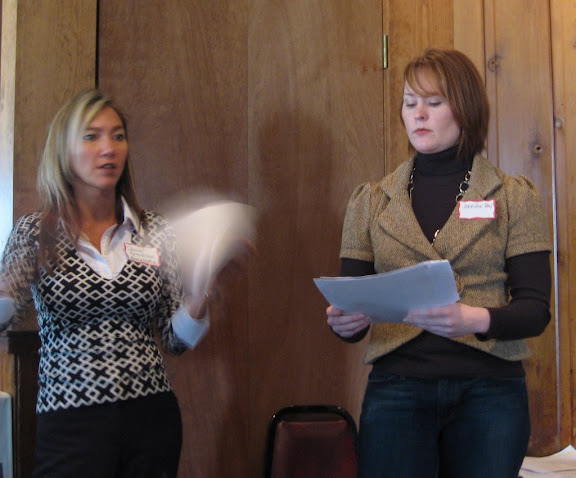
More than 30 attendees heard advice on how to come as close to that ideal situation as possible at “Dirt cheap design,” the title of a March 7 meeting of the Kansas City chapter of the American Society of Business Publication Editors held at Hayward’s Pit Bar B Que in Overland Park, Kan.

The two speakers, Jennifer Ray and Danica Tormohlen, deal with their own art budgets. They seek photography and design help inside and outside their respective companies.

Ray, senior art director with Penton Media in Overland Park, designs for American School & University magazine, which has no design budget, and Club Industry’s Fitness Business Pro magazine, which has a budget of $1,500. Besides winning two Maggies, five TOCAs and one national ASBPE award, Ray also has judged the Maggies, ASPBE and Ozzie awards.

Tormohlen works for Ascend Media Publications in Overland Park and serves as editor of EXPO Magazine, which has a design budget of $500 per month. In 2005, Tormohlen and her editorial team won the Folio; Magazine Eddie Award for Editorial Excellence and the min’s B-to-B of the Web for website redesign.

Stock up
Subscriptions to digital art Web sites have become a cost-effective way to find photos, or at least a more inexpensive way then buying compact discs, Ray said. Another option is the web.

“There are tons of different sites out there,” Ray said. “Some of them are better than others.” The art sites are set up differently. Some allow designers to pay a rate fee to download a certain number of photographs per month or per day. Some digital art websites that offer credit programs to purchase specific pieces.

A few sites worth reviewing include:
Source key
Sources are another way to find art. In her assignment letters to freelancers and full-time writers, Tormohlen tells them to ask for head shots of any or all their sources. Ray likes to work with manufacturers and sometimes asks their help in taking cover photographs. For example, John Deere has its own in-house studio and a library of images.

Both speakers said make an attempt to gain first rights to use photographs. Ray said when outside organizations like manufacturers run a photo shoot for a magazine cover, she requests that the magazine be allowed to publish the photo first before the outside organization publishes it.

EXPO Magazine reports on trade shows and conventions, which normally hire their own professional photographer and then allow publications to use the photographs for free, Tormohlen said. Convention and visitors bureaus at cities playing host to events generally have their own free images, too. Many times the images are ready to be downloaded from a website.

Picture savings
When publications can afford professional photographers, they can save money by hiring the apprentice instead of the head photographer, Ray said. Although not as experienced, the apprentice has access to the same studio and the same camera equipment. Contacting colleges also can lead to finding students who will work for a discounted rate, Ray said. Other photographers will offer a discounted rate if an agreement is reached to use them for a certain number of photo shoots per year.

Magazine cover photographs can eat up a good portion of a design budget, but they offer a great way to get a magazine noticed. Ray said she likes to perambulate through the magazine section of a book store and see which publication covers “pop out.”

Tormohlen said every other issue she tries to do a photo shoot for the cover, which can run $1,000. She selects issues where a story will lead to a good photo shoot.

“Some months we spend zero, and some months we spend $1,000,” she said. “It really depends upon the photographer we get in and where they want to have the photo shoot.”

Take it inside
Ray said her company bought a digital camera that several magazines use. Now, in-house photographers can shoot cover photographs for the two magazines she works for, she said. Publishing companies also might save money by paying for continuing education classes at area colleges, which can allow artists to pick up new skills and negate the need to contract out for such work, Ray said.

Both Ray and Tormohlen said issue reviews, which involve critiquing photographs and designs, can lead to better quality. Tormohlen said she likes to invite people outside the editorial department and art department, such as the publisher, sales representatives and circulation personnel, to a free lunch inside a conference room. There, they can spend about an hour critiquing the latest issue’s design and photography.

Friday, March 02, 2007

Apply for a Young Leaders Scholarship

The ASBPE and TABPI have begun accepting applications for the 2007 Young Leaders Scholarship. The scholarship helps B2B editors who 30 years old or younger attend the ASBPE National Editorial Conference and Awards Banquet.

This year's conference will be in New York City, Aug. 2-3. The scholarship covers the conference fees and hotel-room costs. The ASBPE selects five editors who work in the United States. Winners who are not already ASBPE members recieve one-year memberships. TABPI selects two editors from outside of the United States to attend. TABPI winners receive $500 for airfare.

I was honored to have been selected as a 2006 scholarship winner. Immediate past president of the KC chapter, Amy Fischbach, is a 2002 scholarship winner. I highly recommend young editors to apply. It's a wonderful opportunity to attend the national conference, learn from industry leaders and meet other editors from around the country -- and world.

The application deadline is May 1.

Tabbie Entries Due March 7

You have until Wednesday to get in your submissions for this year's Tabbie awards. The awards are sponsored by Trade, Association and Business Publications International (TABPI) and cosponsored by the ASBPE.

The international awards competition is open to all English-language magazines published at least quarterly.

Click here for a PDF of the entry form.

Thursday, February 22, 2007

March Meeting: Dirt Cheap Design

Creative tips for editors and art directors with limited art budgets

Finally, there's a subject both Editors and Art Directors can agree upon. We're all tired of trying to make our magazines look interesting and inviting to our readers on a virtually nonexistent art budget. In the same boat?

Well, since it's not likely your budget is going to increase significantly any time soon, editors and designers need to put their heads together to come up with creative solutions to this problem. It's not just pretty pictures and commissioned art ... well-chosen (and cheap) devices like pull
quotes, sidebars, photo cutlines, etc. can make your publication more inviting at little or no cost.

The Kansas City chapter of the ASBPE invites you to attend our March 7 meeting at Hayward's Barbeque restaurant in Overland Park (College & Antioch). We'll share the keys for editors and art directors to develop well-designed magazines even on little or nonexistent art budgets.

Who should attend: anyone on your editorial or design staff who is interested in learning (and sharing) ways we can all make our magazines better.

Speakers:
Date: Wednesday, March 7, from noon to 1:30 p.m.

Location: Private room at Hayward's (11051 Antioch St. in Overland Park)

Cost: $20 for members, $25 for non-members

RSVP: To reserve your spot for the luncheon, e-mail asbpekc@gmail.com or call Bill King a 913-338-1503, by Monday, March 5.

Wednesday, January 31, 2007

Work the Web Better

Steve Roll, president of the ASBPE Washington, D.C., chapter has some great tips for improving your online work. Read it here: ASBPE Washington, D.C. Chapter: Online Productivity Tips for B2B Editors.

His top two are the same as mine. If you haven't tried using Firefox instead of Internet Explorer (which no longer supports its Mac version) or Gmail instead of, well, any other mail application (web-based or otherwise), you're missing out on two great resources.

Not only does Gmail allow you to tag messages with as many keywords as you choose (instead of placing each email in only one folder) it has even integrated GTalk, its instant messaging service, which means you can reply to an e-mail as a chat and it's saved in the subject string with the original e-mail.

Google my be taking over the Internet--and therefore the world--but at least its doing it in a friendly, useful way that's free for me. There are some other nice Google features that I've integrated into my workflow:
  • Google Notebook to quickly save snippets from websites that I want to remember.
  • Blogger for this blog. I know some publications are using it as well for their first blog trials. And it has recently undergone a facelift and is easier than ever to use.
  • Docs & Spreadsheets, which allows you to collaborate on documents with others.
And for those of you who do a lot of instant messaging (IM) using a plethora of services (AIM, Yahoo! Messenger, Gtalk, ICQ, MSN Messenger, etc.) you can consolidate. I recommend Gaim (for PCs) and Adium (for Macs). These are two great--and free--programs that compile all of your IM profiles and buddy lists into one easy-to-use interface.

IntelliTXT trouble at Ziff Davis

Ziff Davis' eWeek is getting blasted by the B2B blogs for its use of contextual ads. Below are thoughts posted by Martha Spizziri, the vice president of the ASBPE Boston chapter. (See her original post: ASBPE Boston Blog: eWeek/IntelliTXT Flap.)

In case you missed it: Woburn-based Ziff Davis publication eWeek has been the subject of some Internet controversy for its use of IntelliTXT contextual ads, which are hotlinked from within the text of editorial content. The IntelliTXT service was developed by the company Vibrant Media.

Rather than repeat what's already been said, I'll direct you to some of what's been written about it:

One thing I will repeat that's mentioned in Paul Conley's post: ASBPE's ethics guidelines state

The editorial department should control all editorial content on a publication’s digital publication, including Web site, blogs, e-newsletters, digital magazines, and others. Standards such as accuracy, attribution, fairness, and balance applying to a publication’s printed editorial material also apply to a publication’s Internet or digital presence.

Care should be used online, as with printed material, to avoid placement of advertisements in or near editorial content in a way that could compromise editorial integrity or confuse the reader.


And I do have a few comments about this 2004 post from John Battelle's Searchblog, which Matt McAlister's post above also links to: "IntelliTXT: Your Advertising Peanut Butter Is In My Editorial Chocolate..." Although the piece is almost three years old, Battelle makes an interesting devil's-advocate argument that contextual ads within articles might not be so bad after all. Battelle's reasoning, in brief:

... [M]agazines that are essentially catalog magazines ('magalogs'), or most of the Seven Sisters (Glamour, Vogue, etc) ... pretty much exist to move product, and they don't pretend otherwise. A system like this would work quite well for the online kin to these kind of publications. ...

Second, there are an entire classes of content-driven sites which claim absolutely no pretense of editorial objectivity. Whether they are fan sites, directories, blogs, corporate advertorials, for-profit domain-specific portals, you name it, the tradition of sites which carry their biases proudly or are baldly commercial in nature is rich and growing, and IntelliTXT may well give these kind of sites a new monetization model.

Leaving aside whether directories, blogs, and fan sites are, or ought to be, commercial in nature, I'd say that at best the IntelliTXT model is annoying--in the same way that even editorial links can be annoying when the text is vague. In both cases, you aren't really sure what kind of information you'll get if you click.

IntelliTXT links are distinguished from editorial links by a green double-underline format, and Stevenson tells Battelle that the links are a service, and that the reader won't see the ad unless she makes a conscious choice to click an IntelliTXT link. But the format is not enough to distinguish them as ads to the casual user, at least at this point in IntelliTXT's life. And -- in the 2007 iteration, at least--you don't have to click on the link for the ad to appear. Just rolling over it does the trick.

It's also interesting that, according to Battelle, Stevenson basically argues that the links don't inherently represent a conflict because the publisher decides what words to link, so that if the links aren't appropriate, it's the publisher's responsibility. Battelle doesn't quote Stevenson's exact words, but if Stevenson did in fact mention only the publisher, I wonder why he doesn't think the editor should be the decision maker when it comes to links.

Monday, January 29, 2007

Meeting Recap, Part 2: Target editorial copy by niche to avoid advertorials

Be on the look out for more veiled advertorials in 2007. Phil Musser, publisher of Transmission & Distribution World, said he has seen an increase in the amount of advertorials in his sector of the business-to-business publication industry over the past year.

Some publications are becoming more innovative in how they present advertorials, he said while speaking Jan. 17 at a Kansas City chapter meeting of the American Society of Business Publication Editors titled “Trends in B2B Publishing.” Advertisers often sponsor what a publishing company may call a guide, sourcebook or case study.

“Was that a guide or a sourcebook?” Musser said. “No, it was a different way for them to draw a veil and plop in contributed pieces that were lock, stock and barrel written biased.”

Transmission & Distribution World, based in Overland Park, Kan., and a publication of Prism Business Media, takes a different approach, Musser said.

“We try to make a distinction between a targeted focus of what you’re going after by sector or by niche vs. advertorial,” he said.

He added companies in the business-to-business publication arena can find other avenues of growth:
  • Developing a partnership with an existing trade shows can provide an opportunity if a publishing company or magazine is the exclusive media partner.
  • Blogs and webinars are getting closer to going online for Transmission & Distribution World. The electronic media also can make it easier for Transmission & Distribution World to expand its reach internationally since mailing costs are not involved.
  • A market opportunity exists for research information in the power sector since utilities are not providing financial support to research institutions and associations like they formerly did.
“They are always calling us, asking us for (research information),” Musser said. “That is an opportunity for us.”

Meeting Recap, Part 1: Manage your brand to thrive in online revolution

Brand stewards, although their job titles might say editor, may lead the online revolution in business-to-business publications. Cameron Bishop, president and chief executive officer of Ascend Media in Overland Park, Kan., offered the term and the prediction when he spoke Jan. 17 at a Kansas City chapter meeting of the American Society of Business Publication Editors titled “Trends in B2B Publishing.”

“You are brand stewards,” he told the editors. “You are no longer editors of a magazine. You are managers of a brand.”

Bishop said the title of editor may be outdated. He added the American Society of Business Publication Editors even should consider changing its name.

“I would submit to you that that title is antiquated,” he said of the editor title. “I would submit to you that you all begin to call yourselves directors of content or content managers or content creators. Our business today is about the creation and dissemination of content. It is not about editing a magazine. It is far more than that.”

Bishop defined another term: media agnostic. No longer does content appear solely in print magazines.

“Media agnostic is what we are about today in the creation of content,” he said. Ascend Media delivers content through many outlets — print products, online outlets, e-mal newsletters, wireless handheld PDA devices and various shows and conferences.

The multiple mediums can offer advertising opportunities. Annual growth of 8 percent to 10 percent was common in print publication advertising in the late 1990s, he said, but it’s now fallen to 1 percent to 2 percent.

“The (advertising) budgets are the same, but dollars are being allocated in different ways, and most of those dollars are going online,” he said. Ascend Media saw 500 percent growth in online revenue in 2006, he added.

During the online transformation, editors/brand stewards need to think differently in several areas, Bishop said. Not only should they know the circulation of their publications, they also need to know their websites’ traffic numbers.

“If you don’t know the traffic statistics of your website, you’re not doing part of your job,” Bishop said.

Bishop has challenged Ascend Media to have video capability, such as podcasts, on all its websites within the year. He wants to equip every editorial team with a digital video camera, which he compared to micro cassette recorders. Whereas decades ago reporters began carrying recorders with them for interviews, now they can take digital video cameras.

Editors also should find ways to use print publications to promote the websites. They can put a table of contents for the online product inside the print product.

“Your print product is a promotional vehicle for your Internet product,” Bishop said. “If you don’t choose to think of it as such, then shame on you.”

Thought also should be given to archived content, said Phil Musser, publisher of Transmission & Distribution World, who also spoke at the Kansas City chapter meeting. Transmission & Distribution World, based in Overland Park, Kan., and a publication of Prism Business Media, contracts out content.

“We’re going back now and tagging content,” Musser said. “We’ve got nine years of feature content on the websites. To be able to sell content categories, we’ve got to put it in the right bucket and have the right association.”

Finding veterans for advice on all these online topics could prove difficult, Bishop said.

“There are no experts because it’s all too new,” he said. “It’s a highly entrepreneurial world we’re in today. We’re making it up as we go along.”

Wednesday, January 03, 2007

January meeting: Trends in publishing

The Kansas City chapter of the ASBPE invites you to attend our Jan. 17 meeting, where we’ll discuss the forecast for publishing companies and the challenges magazine staffs will soon face.

Speakers:
Ron Wall, executive vice president of sales and marketing for Ascend Media
Phil Musser, publisher for Transmission and Distribution World at Prism Business Media

Date: Wednesday, Jan. 17, 2007, from noon to 1:30 p.m.

Location: Private room at McCormick and Schmick’s on the Country Club Plaza (448 W. 47th St., Kansas City, Mo., 64112; 816-531-6800)

Cost: $20 for members, $25 for non-members

RSVP: To reserve your spot for the luncheon, e-mail Bill King or call 913-338-1503, by Monday, Jan. 14.

Tuesday, December 19, 2006

MAP dons the Ranlys

The Missouri Association of Publications is starting up a new awards competition for its members called the Ranlys. The competition is named after MAP founder Don Ranly. The deadline is Jan. 16, 2007. You can take a look at the PDF brochure here to learn more about the categories and the entry rules.

Tuesday, December 12, 2006

2007 chapter events

Be sure to mark your calendars so you don't miss out on the great meetings planned for our chapter in 2007.

Jan. 17, 2007
Trends in Publishing

Location: a private room at McCormick and Schmick’s on the Country Club Plaza
Speakers: Executives from the KC B2B companies
Moderator: Incoming ASBPE chapter president Bill King

March 7, 2007
Brainstorming Art Ideas and Designing Infographics

May 16, 2007
Spring Writing and Editing Workshop

July 18, 2006
Ten Ideas for the Web that You Can Implement Tomorrow

Sept. 19, 2007
Copyright Law and Plagiarism
Speakers: A media law professor and a lawyer

Nov. 7, 2007
2007 Magazine Boot Camp

Presented by: The KC ASBPE chapter and the Missouri Association of Publications (MAP)
Speakers: Keynote speaker and three speakers for the following sessions: writing, editing and online

Wednesday, December 06, 2006

Changes to the chapter's board

After doing a great job during their two-year terms, vice president Bill King will become the chapter president and Spring Suptic, a board member, will become the new vice president from January 2007-2009. Congratulations to Bill and Spring, who will do a great job leading our chapter for the next two years.

Amy Fischbach, who served as the president of the chapter from 2005-2007, will become the immediate past-president of the chapter.

Jody Shee, who made many valuable contributions as the secretary of the chapter, has decided to resign.

Become a board member
If you're interested in serving on the ASBPE Kansas City chapter board from 2007-2009, please send your resume to asbpekc@gmail.com. Thank you!

Monday, November 20, 2006

Competition brochures mailed today

Entry brochures for the Azbee Awards of Excellence were mailed out today. If you are on our mailing list, you should receive yours in the next couple of weeks. If you don't want to wait or are not sure you're on the list, you can just use our online entry form or download a PDF version of the form (831K).

Note: Martha Spizziri is vice president of the ASBPE Boston/New England chapter. She is posting to this site while ASBPE-KC blog administrator Spring Suptic is away.

Thursday, November 16, 2006

"Better to ask for forgiveness than for permission"

Note: "Better to ask for forgiveness than for permission" comes from the ASBPE Boston blog.

Those words come from Neal Vitale, CEO of 1105 Media, as quoted in Folio:'s report on today's CEO roundtable at American Business Media's Top Management Meeting. According to the report by Folio:'s Matt Kinsman, "the CEO panel emphasized that the transformation facing publishers isn't just about adapting online but breaking established, outdated molds throughout their companies."

Vitale's comment had to do with moving corporate focus away from the bottom line. The full quote from Vitale, as it appears in Kinsman's article, was this: "We want there to be a sense that it's better to ask for forgiveness than for permission. If people have a good idea, don't wait around for approval from the budget department."

Other highlights from Kinsman's report:
  • Panelists stressed the importance of investing in the company and fostering entrepreneurship, even in the face of the lean times we've seen recently.

  • Vance Publishing president and COO Peggy Walker noted that her company has had to rethink its decentralized organizational structure; the energy and resources expended on multiple small projects could have been used on larger projects that might have benefitted the company more. That advice seems to contradict the point immediately above, and Vitale's comments, which seem to call for a less-centralized decision-making structure. Perhaps the point is to be flexible and rely on common sense, not fads or trends, in deciding when and how to remake your business.

  • With 18 different publications, Farm Progress Companies suffered from overlap among titles. Kinsman quotes company president Jeff Lapin as saying. "Advertisers recognized us as a strong brand, but said we just did the same content across 18 magazine[s]." It must have hurt to hear that. Farm Progress deserves credit for taking the advice to heart and overhauling its offerings.

  • Also of note: As part of its revamp, Farm Progress entered the consumer market with a new magazine called Rural Life.

  • Interestingly, Vance Publishing brought on board staff members it referred to as "change agents," including a new human resources staffer.

  • Also in the human resources arena, McGraw-Hill's Harry Sachinis advocated what he called "overhiring," noting that the company hired a former astronaut and aviation-industry executive to head up its AviationWeek group.
It's nice to hear all this emphasis on investing in products and personnel coming from corporate leaders, but it's hard not to think that for many companies -- especially given the recent economic situation in the industry -- such investments are just not an option. And fostering an entrepreunerial culture is something much easier said than done. Still, there are companies that seem to manage one or both feats fairly successfully (IDG comes to mind). The hard part is figuring out how they do it, and how to replicate that success. At one of last year's [Boston] chapter meetings, it became evident that innovation often happens under the radar.

Related link:
Other B2B media news today from Folio:
Martha Spizziri is vice president of the ASBPE Boston/New England chapter. She is posting to this site while ASBPE-KC blog administrator Spring Suptic is away.

Online Azbee entry form posted

The online version of the Azbee Awards for Excellence entry form is now available. This form lets entrants fill out and submit entry information online instead of filling out paper forms, and basic publication information and contact information can be entered just once for multiple entries.

A PDF version (831K) of the Azbee Awards for Excellence entry form that can be downloaded, printed, and mailed in is also available. Hard copies of the entry brochure will be mailed out in a few weeks.

And don't forget: We've added 16 new categories, in these areas:
  • Multi-Platform
  • Print Magazine Editorial
  • Print Magazine Design
  • Print Newsletter Editorial
  • Print Newsletter Design
  • Digital Magazines
  • E-Newsletter
  • Blogs
  • Web
A full list of new categories is here.

Martha Spizziri is vice president of the ASBPE Boston/New England chapter. She is posting to this site while ASBPE-KC blog administrator Spring Suptic is away.

Wednesday, November 15, 2006

Airing problems in science, industry, and reporting

Note: Airing Problems in Science, Industry, and Reporting comes from the ASBPE Boston blog.

The PBS show AIR: America's Investigative Reports is always fascinating viewing. Each episode looks at the reporting behind a specific investigative story. Last week's episode, "Science Fiction," was of particular interest for professional, industry, and association publications, though. It centered on reporting done by Environmental Science & Technology, which is published by the American Chemical Society.

Paul D. Thacker, who was a reporter at ES&T, starting finding evidence of deliberate attempts to slant science news to benefit certain industries. Among Thacker 's findings:
  • Steven J. Milloy, the publisher of JunkScience.com, which criticizes scientific research findings on topics like global climate change and health issues, was a science consultant for Philip Morris at the same time he was debunking the risks of second-hand smoke on Fox New's web site. (At this writing, JunkScience.com has posted no statement about the AIR episode.)

  • A purportedly grassroots activist group in Oregon called Project Protect was connected to the timber industry. The group advocated for cutting down trees as means of preventing forest fires, a position also espoused by the industry.

  • The consulting firm The Weinberg Group submitted a proposal to DuPont detailing ways to defend an allegedly carcinogenic chemical used in Teflon.
Thacker reported on these issues in ES&T (see Related Links, below, for stories accessible to non-ES&T subscribers). He received acclaim for his work -- including an award from the Society of Environmental Journalists -- and got positive feedback from readers.

Thacker's story especially resonated because of the recent publication of ASBPE's book Journalism That Matters, which tells how B2B writers reported articles that brought about positive change in their industries. But Thacker's reporting didn't result in quite such a happy outcome as those in the book.

An American Chemical Society board member questioned the value of Thacker's reporting on the Weinberg group, and Thacker says he was soon asked to stop doing investigative pieces. When he found evidence that the Bush administration had tried to stop scientists from discussing connections between climate change and hurricanes, ES&T wasn't interested in publishing the story, he says; in September his climate change story was published on Salon.com. Thacker says he was later fired by ES&T. (The magazine has released a statement about the AIR report and Thacker's departure from the magazine, saying among other things that American Chemical Society rules prohibit board members from interfering with publication editors' activities. Thacker now works for the web site Inside Higher Ed.)

If you get a chance to catch a repeat of the episode, or any installation of AIR, I highly recommend it. And for a look at techniques business press reporters used to get key information for controversial articles, see this report from the ASBPE Washington, D.C., blog.

Related links: Martha Spizziri is vice president of the ASBPE Boston/New England chapter. She is posting to this site while ASBPE-KC blog administrator Spring Suptic is away.

Azbee entry forms now available!

Note: Azbee Entry Forms Now Available! is adapted from the ASBPE Boston blog.

A PDF of the entry form (831 KB) for the 2007 Azbee Awards of Excellence is now available.

Hard copies of the entry brochure will be mailed out in a few weeks, and a form that can be filled out and submitted online* will be posted on the ASBPE web site as well.

ASBPE has added 16 new categories to the competition, greatly expanding the digital and newsletter portions of the competition. In the print magazine area, there are new categories for headline writing, buyer’s guide s, product sections, and overall photography/illustration. A full list of new categories is here.

* Be aware that copies of magazines and other materials still must be mailed in for most categories even when submitting the form electronically.

Martha Spizziri is vice president of the ASBPE Boston/New England chapter. She is posting to this site while Spring Suptic is away.

Tuesday, November 14, 2006

ASBPE National Conference Heads for New York;
Awards Program Adds Digital, Newsletter Categories

Note: ASBPE National Conference Heads for New York; Awards Program Adds Digital, Newsletter Categories comes from the ASBPE Boston blog.

For the first time ever, ASBPE's National Editorial Conference will be held in New York City. The conference and the national Azbee Awards of Excellence banquet will be held at The Roosevelt Hotel in midtown Manhattan on Aug. 2-3, 2007 (a Thursday and Friday). The national Azbee awards banquet will be held at the hotel the night of Aug. 2. For more details, see the ASBPE web site.

Speaking of the Azbees, the digital and newsletter categories have been greatly expanded. The most exciting new award is for General Excellence in Multi-Platform Journalism; it's the first time ASBPE is presenting a multi-platform award. There also are six new digital categories, five additional print newsletter categories, four new print magazine categories, and four category name changes. Details on the changes are here.

Martha Spizziri, vice president of ASBPE Boston, will be posting to this blog while Spring Suptic is away. Spring returns on Monday, Nov. 27.

Update, Nov. 14, 2:22 p.m. CST: Entry forms (831K PDF) are now posted on the ASBPE web site.

Monday, November 13, 2006

Change Agents: Trade Pubs Making a Difference

Notes: Change Agents: Trade Pubs Making a Difference comes from the ASBPE Washington, D.C. blog. Some links were added.

Martha Spizziri, vice president of ASBPE Boston, will be posting to this blog while Spring Suptic is away. Spring returns on Monday, Nov. 27.


Journalism That Matters, ASBPE's book on high-impact articles, was the focus of an ASBPE chapter panel presentation in Washington, D.C. on October 12, 2006. The book (available on Amazon.com) features case studies built around industry-changing articles from English-language business publications around the world (US, UK, Canada, Australia, etc.).

The panel was moderated by Steve Roll, editor with BNA. Roll, who is D.C. ASBPE's chapter president, and co-editor of the book, said he is struck by his encounters with award-winning editors who are proud of "not so much the award, but the change that[their] piece triggered within a particular industry." He said that the book contains both investigative pieces and "elephant-in-the-room" stories where biz pubs are the first to tackle large industry problems.


The four panelists summarized their case studies which appear in the book. John Gannon, senior editor with BNA's Right-to-Know Planning Guide, discussed his coverage of Material Safety Data Sheets (MSDS), which are supposed to warn of dangers posed by the use of chemicals in the workplace. He noticed that problems with the sheets kept cropping up in Chemical Safety Board reports where faulty information had caused explosions and even deaths. "Can you imagine if you go to the store and you buy medication, and two times out of six if you follow the directions you end up in the hospital or dead?" Gannon asked rhetorically.

Gannon tried to get answers from OSHA and EPA. "OSHA acted so strange about it, I figured there must be something here," he said. He eventually turned to plaintiffs' lawyers and victims families for big pieces of the story. After he started reporting on the issue, a Senate hearing was held and a professional association called for corrective action.

Patience Wait, senior writer for PostNewsweek Tech Media's Government Computer News, followed up on a tip about a deputy CIO in the then two-month old Department of Homeland Security who claimed a doctorate degree on her resume from what subsequent investigation revealed was a diploma mill. The only requirements for the degree were two short papers. The school granted credit hours for "life experience" to cover all course requirements. Upon graduation, the school provided a transcript listing specific courses but giving no indication they were all waived. Wait found that it is a criminal offense in Oregon to claim a degree from the school in question (and others listed on a state website) on any job application, public or private, in the state.

She broke the story online to scoop other reporters who were beginning to sniff around. "Three days later," she said, "I got another email from another person saying 'didn't you know that she claims that all three of her degrees come from the same school?'" National media picked up the story and congressional hearings were held. The woman in question went on paid leave and ultimately resigned.

Jeanne LaBella, vice president of publishing for the American Public Power Association, published a six-part series about electricity pricing in her magazine in 2004. Most of APPA's members are electric utilities that are owned and operated by municipal governments. Historically, utilities would allocate costs and set rates according to the size of the customer. If a town had a large industrial plant that consumed 60 percent of the power, then 60 percent of overhead and facilities (lines, substations, etc.) was allocated to that customer.

APPA's chief economist advocated a different pricing scheme based on whether power was being consumed during peak or off-peak hours. Think of " how a hotel is priced," LaBella said. "If you go to the beach in the summer, you're going to pay one price for your hotel room. If you go to the beach in the winter, you're going to pay a much lower price. The same concept should be applied to electricity." Letting prices fluctuate with demand would signal customers when to back off from heavy consumption.

This was heresy in the industry, LaBella said. Reader reaction was strong and she got many requests for extra copies of the magazine so readers could pass it around to their colleagues. "Ultimately, the series led to the formation of a group of utilities from across the nation who started looking very seriously at the ways that they would redesign electric rates to come closer to the kinds of things that [the economist] was advocating in his article," LaBella said.

Molly Moses, editor/reporter with BNA's Transfer Pricing Report, started hearing in 2004 that Canadian tax authorities were taking outrageous positions in transfer tax negotiations. At issue were tax liabilities arising from imputed cross-border 'sales' of goods and services between parent and subsidiary corporations.

Moses found that company sources were reluctant to speak. "Nobody wanted to go on the record with this because they all have cases and they don't want to poison the negotiations," she said. She got around the problem by talking to a knowledgeable source at a trade association which represented the companies involved. "She could just go off on this issue without repercussions to any one company," Moses said.

After the story was published, "what was really gratifying was I could tell that it had an impact [because] cases started to move after that," Moses said. Not only did negotiations start to go smoother, but new understandings were reached among the parties as to how to resolve
disputes.

Much of the question-and-answer session that followed revolved around getting past public relations departments who are sometimes overzealous gatekeepers. Patience Wait suggested trying to talk to the source at a public event. Another tactic: "You come in unobtrusively directly to the person that you want to talk with, and get them to agree that, if public affairs signs off on it, they'll talk to you," Wait said. You may find that the source will give you clues off the record and is willing to go on the record if public affairs clears it.

John Gannon said these techniques would not work at OSHA where every staff member is well-trained not to speak to the media under any circumstances without public affairs' approval. He used a different tactic after an OSHA public affairs officer didn't answer his questions and kept stringing him along. "I eventually had enough stuff that she either didn't know [or] couldn't find out that I sent her an email ... and said that when my story comes out, I'm going to do a sidebar about all the things that you don't know. I think that's going to be very interesting to my readers," Gannon said. Cooperation improved immediately thereafter. Threaten early, Gannon advises, don't let it drag on for two months like it did in this case.

Related links (added by ASBPE KC):

Monday, October 30, 2006

Catch bad copy

Boot Camp attendees brush up on editing style and techniques
By Jeff Geleski, board member, Kansas City chapter, ASBPE

Ron Johnson, an assistant professor of journalism for Kansas State University, said he took on the role of bad cop at the event. He put those in attendance in grammar school by serving a style quiz. Numerals, capitalization and even sexism — it’s police officer and not policeman — were covered in the quiz.

Johnson’s talk was called “Brushing up on AP style and advanced editing techniques.” He listed some of his pet peeves during his presentation. For example, major, unique, reaction and impact all are overused words, he said. Using parentheses inside quotes are problematic, Johnson said, for three reasons: The parenthetical detracts from the accuracy of quotes, it’s weak writing and it makes the source appear stupid.


Having taught at Kansas State since 1989, Johnson said he tells his students to know the difference between a colon and a semicolon, and then he tells the students to try to avoid using them. It upsets him when students fail to correctly use “its” and “theirs.”

“This drives me insane,” he said.

Johnson added he tells students to edit with a dirty mind, or know when readers might consider another meaning of a word. Saying someone will head a company may not be a good idea in a headline.

While most copy editors already know to use the Associated Press stylebook and dictionaries, Johnson said not all dictionaries are equal.

“Some are stronger than others,” he said.

The book Words on Words by John Bremner is another good resource for copy editors, he added.

Copy editors, he said in closing, should think of themselves as part of a team. They should be proactive in helping reporters make changes in any grammar or style weaknesses they have.

During the break following his session, Johnson critiqued design elements of attendees' magazines. A graduate of Fort Hays State University in Hays, Kan., Johnson is the editor of The Best of Newspaper Design, a 272-page book that showcases the nearly 1,500 winners in the Society for News Design’s international competition.

Links