The Kansas City chapter of the ASBPE is looking for editors to join our board.
If you enjoy coming to our meetings, maybe you'd like to help plan them. Board members meet over a long lunch to plan an event and then each person helps to put that plan into motion.
With the ASBPE National Conference this July, it's a great time to join the board. Kansas City board members will have a special opportunity to rub shoulders with the ASBPE national leaders and speakers.
Please send an email indicating your interest and your resume to asbpekc@gmail.com.
A note of thanks
The Kansas City chapter would like to thank outgoing president Bill King for his years of dedicated service on the board. This chapter has benefited greatly from Bill's industry knowledge, guidance and amazing organizational skills.
Friday, February 15, 2008


Thursday, February 14, 2008
Meeting Recap: Creating community on the web
A website can serve as a community meeting spot for an industry. Business-to-business publications should know the tools and tactics needed to keep industry members coming to their web sites and staying there, said Sandi Brown, director of audience development, new media, for Penton Media, Overland Park, Kan.
Brown served as a moderator for a meeting titled “10 ideas for the Web that you can implement tomorrow” that took place Feb. 6 at the Brookridge Country Club in Overland Park, Kan. The Kansas City Chapter of the American Society of Business Publication Editors sponsored the event.
Repurposing content from print and creating a community are two aspects for online publications. Club Industry’s Fitness Business Pro, Overland Park, Kan., categorizes content in its online “Resource Center,” said Stuart Goldman, managing editor. Stories are placed in such categories as for-profit health clubs; nonprofit facilities; and schools and universities.
Broadcast Engineering, Overland Park, Kan., offers a glossary of terms, including acronmyms, on its website, said Spring Suptic, associate editor. Editors originally came up with the glossary of terms for their own use and then decided it would be a good idea to share it with the industry on the website.
B-to-B publications may consider both in-house blogs and other blogs concerning their industries for their web sites, Brown said. Club Industry’s Fitness Business Pro found its blog gets many hits even though few visitors choose to leave comments, Goldman said.
Broadcast Engineering pulls the RSS feeds from blogs written by people in the industry, Suptic said. Brown said it’s a good idea to ask the blogger for permission to use the blog on the website. This request may lead the blogger to add a link to your magazine on his or her blog, Brown said.
“There’s this whole click-through magic that happens,” Brown said.
Links from your website to other websites and from other web sites to your web site helps to improve your status on search engines, such as Google, Suptic said. It tells the analytics the search engines use that your site must be trustworthy with good content because others are linking on to it.
Companies should remember they have no editorial control of a blog that is not an in-house blog, Brown said.
“You just have to make that commitment that you are going to take on all-comers,” Brown said. “You have to know what works for your environment.”
10 ideas for the Web that you can implement tomorrow
1. RSS feeds
RSS (Really Simple Syndication) is a format for sharing and distributing Web content, such as news headlines. RSS feeds let readers know about new content on your site.
For an example see www.vetecon.com.
Free RSS applications are available at www.feedburner.com.
2. Polls and quizzes
Ask your readers what they think. The results can be used in print.
Free/cheap online applications are available at www.pollmonkey.com and www.polldaddy.com.
3. Online forms
Forms and handouts are popular reader tools. Posting them online brings readers to your site and doesn’t take up any valuable real estate in your book.
For examples see www.vetmedpub.com.
4. Reader comments
Allowing readers to leave comments at the bottom of a story can generate interest and activity on your website. But companies should designate somebody as the editor of comments. Posting comments on the site instantaneously could lead to problems, such as one company trashing another company.
For an example see www.kansascity.com.
5. Recycled content
Content is king! Make use of already written material by posting it all online.
For an example see www.broadcastengineering.com, which has all articles published in the U.S. and World editions going back to September 2000. All the content from the newsletters is used on the website as well.
6. Slideshows
Pictures are worth a 1,000 words. And posting extra photos online makes good use of photos that you can’t fit in the book.
For an example see www.vetmedpub.com/extras/caribou.
Free applications are available at www.slide.com.
7. Behind-the-scenes blog
Let your readers know what you’re working on by launching a magazine blog. Ask each of your editors to write a blog entry once or twice a week. With this blog, you can educate your readers about the inside workings of your magazine and also reach out to potential sources for stories.
For an example see blog.fitnessbusinesspro.com/fitnessbusinessproblog/.
8. Resource center
Group all of your related articles into sections on your website. Along with listing articles, you can also include other helpful tools and information for your readers.
For an example see fitnessbusinesspro.com/forprofits/.
9. Industry blog portal
Find readers who blog about your industry. Use the blogs’ RSS feeds to pull snippets of content to your site, creating a content portal.
For examples see broadcastengineering.com/be-roll and nashvilleistalking.com.
Free/cheap online applications are available at www.feeddigest.com and pipes.yahoo.com.
10. Top 10 lists
People visiting your site want your best content. Give them the 10 most read articles, most e-mailed articles, the 10 best interviews, etc.
For an example see www.cfo.com.
Monday, January 28, 2008
Journalism fellowship opportunity
The Rosalynn Carter Fellowships for Mental Health Journalism provides six one-year fellowships for journalists to study a selected topic regarding mental health or mental illnesses. Each journalist awarded will receive a $10,000 stipend. Applicants must have at least three years of professional experience in journalism.
Contact: Jane Bigham, 404-420-3877, jane.bigham@emory.edu.
Contact: Jane Bigham, 404-420-3877, jane.bigham@emory.edu.
Friday, January 18, 2008
February meeting: 10 ideas for the Web that you can implement tomorrow
The Kansas City chapter of the ASBPE invites you to attend our February luncheon. We’ll have a Web initiatives show-and-tell of what editors can do online without heavy investment from their new media departments. This is an opportunity to learn from other editors and share your own ideas and experiences.
Moderator: Sandi Brown, Director, Audience Marketing, New Media, Penton Media
Date: Wednesday, Feb. 6, from noon to 1:30 p.m.
Location: Brookridge Golf & Country Club (103rd St. between Metcalf Ave. and Antioch) MAP
Cost: $20 for members, $25 for non-members
RSVP: To reserve your spot for the luncheon, e-mail Spring Suptic at spring [dot] suptic [at] penton [dot] com, or call 913-967-1644, by Wednesday, Jan. 30. Please make note of any special diet requirements.
And, most important, share your ideas! What has worked for you on the Web? What hasn't? What are you thinking of trying next? What do you want to know more about?
Wednesday, November 14, 2007
Nationals comes to town
We're proud to announce that the ASBPE National Conference and Azbee Awards Banquet will take place next year in Kansas City!
Mark your calendars for July 24 and 25, and make plans to spend them with us at the Intercontinental Hotel on the Country Club Plaza.
Have an idea for us? Send it to asbpekc [at] gmail [dot] com.
Mark your calendars for July 24 and 25, and make plans to spend them with us at the Intercontinental Hotel on the Country Club Plaza.
Have an idea for us? Send it to asbpekc [at] gmail [dot] com.
Sunday, August 12, 2007
Meeting Recap: Freelance contracts need to address copyright, plagiarism
Editors wanting to avoid copyright and plagiarism legal problems need to focus on the specifics of contracts with freelance writers, said Jean Maneke of The Maneke Law Group in Kansas City. Be aware of electronic archive rights within those contracts, too, she said.
Maneke, who has represented the Missouri Press Association as its hotline attorney since 1991, was the featured speaker in “A Copyright and Plagiarism Primer” presentation given Aug. 8 during a Kansas City chapter of the American Society of Business Publication Editors’ luncheon at McCormick & Schmick’s in Kansas City.
Maneke said editors should ask themselves three questions when dealing with copyright issues:
Another issue might pop up if a third party, perhaps another publishing company, asks the editor for permission to use the freelancer’s story. Does the freelance contract give the editor the right to allow such permission?
“Those are the kinds of things you need to think about when dealing with copyright,” Ms. Maneke said.
Plagiarism can occur among both writers employed by the publishing company and freelance writers. Every freelance contract should say plagiarism will not be tolerated, Maneke said, but that step still will not keep publishing companies out of trouble. They still will be liable even if the freelance writer plagiarized a story without the company’s knowledge.
The publishing company can turn around and sue a freelance writer if the publishing company is sued for plagiarism, but that tactic may meet with little success. If a publishing company faces a $1 million fine, it can sue the freelance writer, but a good chance exists the freelance writer will be unable to pay a $1 million fine, she said.
It may be impossible for editors to catch plagiarism before publication, Maneke said. No one has time to use Google on the Internet to research whether stories were plagiarized.
Editors should know what constitutes plagiarism. Publishing companies legitimately may use material from another source provided the material is presented as news or education and the other source receives attribution, she said. Just don’t use the entire story. Logos and photographs can be used as long as they are part of news material.
She added paraphrasing a statement does not avoid plagiarism and words lifted in their entirety must have quote marks. Use of facts is not plagiarism, but if the facts contain the original author’s interpretation, they must have attribution.
Advertising is different. Problems may arise in certain situations, such as when you use a photograph or a song for an advertisement, or where you are making money off the photo or song.
Maneke added editors need to know the difference between copyright and trademark.
“Everybody confuses copyright and trademark,” she said.
Copyright is the expression of an idea in tangible form. A trademark represents a product or service.
Copyright rights exist for anything that is put down on paper. You do not have to register to have copyright rights, but you must register if you want to file suit. The Library of Congress has copyright forms that you may fill out online.
Maneke, who has represented the Missouri Press Association as its hotline attorney since 1991, was the featured speaker in “A Copyright and Plagiarism Primer” presentation given Aug. 8 during a Kansas City chapter of the American Society of Business Publication Editors’ luncheon at McCormick & Schmick’s in Kansas City.
Maneke said editors should ask themselves three questions when dealing with copyright issues:
- What rights do I have?
- What rights am I taking away from somebody?
- What rights am I giving to somebody else?
Another issue might pop up if a third party, perhaps another publishing company, asks the editor for permission to use the freelancer’s story. Does the freelance contract give the editor the right to allow such permission?
“Those are the kinds of things you need to think about when dealing with copyright,” Ms. Maneke said.
Plagiarism can occur among both writers employed by the publishing company and freelance writers. Every freelance contract should say plagiarism will not be tolerated, Maneke said, but that step still will not keep publishing companies out of trouble. They still will be liable even if the freelance writer plagiarized a story without the company’s knowledge.
The publishing company can turn around and sue a freelance writer if the publishing company is sued for plagiarism, but that tactic may meet with little success. If a publishing company faces a $1 million fine, it can sue the freelance writer, but a good chance exists the freelance writer will be unable to pay a $1 million fine, she said.
It may be impossible for editors to catch plagiarism before publication, Maneke said. No one has time to use Google on the Internet to research whether stories were plagiarized.
Editors should know what constitutes plagiarism. Publishing companies legitimately may use material from another source provided the material is presented as news or education and the other source receives attribution, she said. Just don’t use the entire story. Logos and photographs can be used as long as they are part of news material.
She added paraphrasing a statement does not avoid plagiarism and words lifted in their entirety must have quote marks. Use of facts is not plagiarism, but if the facts contain the original author’s interpretation, they must have attribution.
Advertising is different. Problems may arise in certain situations, such as when you use a photograph or a song for an advertisement, or where you are making money off the photo or song.
Maneke added editors need to know the difference between copyright and trademark.
“Everybody confuses copyright and trademark,” she said.
Copyright is the expression of an idea in tangible form. A trademark represents a product or service.
Copyright rights exist for anything that is put down on paper. You do not have to register to have copyright rights, but you must register if you want to file suit. The Library of Congress has copyright forms that you may fill out online.
Tuesday, July 17, 2007
August meeting: A copyright and plagiarism primer
The Kansas City chapter of the ASBPE invites you to attend our August meeting. We'll share the key elements that all editors and art directors need to know about copyrights and plagiarism in print and on the web.
Speakers: Jean Maneke of The Maneke Law Group
Date: Wednesday, Aug. 8, 2007, from noon to 1:30 p.m.
Location: Private room at McCormick and Schmick’s on the Country Club Plaza (448 W. 47th St., Kansas City, Mo., 64112; 816-531-6800)
Cost: $25 for members, $30 for non-members
RSVP: To reserve your spot for the luncheon, e-mail Bill King or call 913-338-1503, by Monday, Aug. 6.
Also: We will be honoring the Kansas City Area regional winners in ASBPE’s 2007 Azbee Awards of Excellence
Thursday, July 05, 2007
Act now to save on attending the ASBPE National Conference
If you haven't already, now is the time to register to attend the 2007 ASBPE National Editorial Conference and Azbee Awards of Excellence banquet in New York City, Aug. 2-3, at The Roosevelt Hotel.
Monday, July 9 is the deadline to get the group rate of $229 a night at the
hotel.
Next Friday, July 13 is the deadline for early registration discounts for the
conference and national awards banquet. Registering before then will save you $25 per banquet
registration, $100 on one-day conference attendance, and up to $180 (non-members) or $80 (members) on full conference registration.
You can register online (credit card required) or get a printable registration form (1.2MB PDF).
Friday, June 15, 2007
Question of the week #8
How is blogging from a game any different than radio coverage?
They are both live coverage, says Lance Jugmeyer, editor of The Packer at Vance Publishing. His question and comments are in response to a recent news clip from the Courier-Journal. According to the paper, the credentials of one of its reporters was revoked because he was blogging from the press box at a University of Louisville game. The paper says the move imposes on First Amendment rights. The school says it was merely following the policies set by the NCAA. For the full story, click here.
(Thanks to our ASBPE KC secretary Jeff Geleski who provided the news clip.)
Friday, May 25, 2007
Workshop Recap: Details add energy to your stories
Recognize where your story has energy, John Lofflin said. Then think about moving that part of the story closer to the top, he added.
A journalism professor at Park University in Parkville, Mo., Lofflin also serves as special assignment editor for Veterinary Economics, an Advanstar Veterinary Healthcare Communications publication based in n Lenexa, Kan. He gave the presentation “The Art of Storytelling: How to Make a Boring Story Interesting” at the Spring Writing and Editing Workshop on May 15 in Overland Park, Kan. The Kansas City chapter of the American Society of Business Publication Editors organized the event held at the Brookridge Country Club.
Lofflin said he finds it difficult to explain his energy theory to students. The energy happens when a writer, at one point in the story, recognizes he or she has nailed it and becomes inspired. The writing happens at a quicker pace.
Sometimes a direct quote sparks the energy. Details give a story energy, too.
“Detail is a thing you have to learn to see,” he said.
Details can give a reader a sense of being at the event, or peering over the reporter’s shoulder during an interview. Details can cause a reader to interact with the story on a sensual level.
Even if reporters are unable to attend an event in person, they can use other tactics to obtain detail. Lofflin said he uses Google Earth on his computer to learn about places. Using this strategy once, he said he felt confident calling a Colorado town a two-story town.
He gave another example of calling back a veterinarian while writing a story about animal abuse. He wanted to know the weight of a cat that had died. It led to this sentence: “Excuse Dr. Brett Levitsky if his blood still runs hot when he’s asked to remember that April day in 2004 when 9-pound Darwin was laid on his exam table DOA.”
Tuesday, May 22, 2007
Workshop Recap: Keep clutter out of your stories
This lead just won’t do: Ron Johnson talked about copy editing Tuesday afternoon.
Ron Johnson even said it won’t do, and he has taught editing and design classes at Kansas State University since 1989. Johnson gave the presentation “Big Picture Editing Techniques: The Nuts and Bolts of Weaving a Story Together” at the Spring Writing and Editing Workshop on May 15 in Overland Park, Kan. The Kansas City chapter of the American Society of Business Publication Editors organized the event held at the Brookridge Country Club.
Besides weak leads, Johnson gave suggestions on making transitions brief, providing just enough background information and avoiding paragraphs that say the same thing as the quotes that follow.
“Don’t make people hack through your verbiage to get to your cool stuff,” he said.
Johnson said writers may decide on a news lead and use the “who, what, when, where and how” of a story. However, he added, you do not need all five of those elements in the lead. You can select the most important ones for the first paragraph and add the other ones later.
Narrative leads, he said, can allow a writer to use one person’s perspective to illustrate the story’s big picture. Narrative leads tend to work better in longer stories, he said.
Stories in trade publications generally need adequate background information early on in the story, he said. Writers should try to summarize the information in a sentence or two.
Diversify sentence lengths and paragraph lengths throughout the story, he said. While reporting, writers should shop for a lead quote and a concluding quote. The lead quote can go high up in the story, like in the second or third paragraph.
And to finish? Johnson said, “The direct quote is about always the best way to end a story.”
Monday, May 21, 2007
Workshop Recap: Place content in various media platforms
The day of relying solely on print publications for revenue and readers is gone. Surveys show nearly half of the people who read newspapers online do not read the print editions, said Tom Eblen, a newspaper consultant and retired University of Kansas professor. Like the rest of the journalism industry, business-to-business publishing companies need to utilize various forms of media, not just print.
Eblen gave the presentation “The Straight Scoop: Radical Changes in Communications and How to Adapt to Continue to Serve our Readers” at the Spring Writing and Editing Workshop organized by the Kansas City chapter of the American Society of Business Publication Editors. The May 15 event was held at the Brookridge Country Club, Overland Park, Kan.
Eblen gave two examples outside of business-to-business publishing as ways to use media platforms successfully.
ESPN’s content lives on all media platforms, Eblen said. The company’s product can be found anywhere, from video games to mobile phones to websites. Walt Disney, ESPN’s parent company, now wants all of its companies to follow ESPN’s example, he said.
Closer to Kansas City, Eblen pointed to the success of The World Company in Lawrence, Kan. The company places stories in its print publications (the most well-known being the Lawrence Journal-World), online and on TV (the company owns Channel 6, a Lawrence TV station). The media outlets often cross promote each other.
Business-to-business publications may have an advantage over other media outlets, such as daily newspapers, Eblen said. A B-to-B publication wants to reach a segmented, specialized audience. Across all media platforms, a B-to-B publication may have a defined marketplace, as opposed to an undifferentiated marketplace.
When deciding how much to invest in online content, publications should know the average age of their readers. People under 30 tend to turn to online content exclusively for news, he said. People in their 50s are more likely to read newspapers.
Websites should be simple to use. No task should require 10 clicks of a computer mouse. Magazine content from at least 10 years back should be on website archives. Every publication should have its own website and lead in its category.
Thursday, May 17, 2007
Wanted: Bilingual associate editor
At Vance Publishing, we need a Bilingual Associate Editor for the The Packer within Vance’s food360° Division. You will play a key role in integrating our products and expanding our presence into the Hispanic market.
As the Associate Editor you will:
Please send your resume, salary requirements and relevant clips/URLs to: Vance Publishing Corporation ATTN: Human Resources 400 Knightsbridge Parkway Lincolnshire, IL 60069; Fax (847) 634-4336; humanresources@vancepublishing.com.
As the Associate Editor you will:
- Receive assignments and evaluate news leads to develop stories for both print and online media
- Gather and verify factual information regarding the story by interview, observation and research
- Translate existing articles into both languages
- Coordinate and edit copy from freelancers
- Travel to industry events and conventions
- Travel to growing regions in the U.S. and Latin America for enterprise reporting
- Take photography and video during your travels
- Bachelor’s Degree in Journalism or equivalent experience
- Bilingual language skills (Spanish/English)
- Two years of reporting experience preferred
- Superior writing and editing skills
- Proficiency with HTML
- Valid passport is required.
Please send your resume, salary requirements and relevant clips/URLs to: Vance Publishing Corporation ATTN: Human Resources 400 Knightsbridge Parkway Lincolnshire, IL 60069; Fax (847) 634-4336; humanresources@vancepublishing.com.
ASBPE on hypertext ads
For an update on the debate about sponsored links in editorial content on the web, check out this article on the national ASBPE website: "What ASBPE, B2B bloggers said about paid links in articles."
Wednesday, May 09, 2007
Only two days left to register!
Our Spring Writing and Editing Workshop is just around the corner, have you called Bill King to reserve your spot?
With three power-house journalism professors, this is an afternoon you won't want to miss.After a delicious lunch at the Brookridge Country Club, Retired KU professor Tom Eblen will help you to step back and take a fresh look at your publication.
And by popular demand, Professor Ron Johnson is returning to help us brush up on those tricky, advanced editing techniques.
We will end our afternoon with Professor John Lofflin, who will discuss the art of storytelling, and how to make it work for your publication--no matter the subject matter.
To reserve your spot, call or e-mail Bill King (913-338-1503 or BillKing@penton.com) by noon on Friday.Date: Tuesday, May 15, from 11:30 a.m. to 4:00 p.m. (includes lunch)
Cost: $55 for ASBPE members, $70 for non-members, $30 for students
Monday, May 07, 2007
Ethics controversy continues at Ziff Davis; ASBPE clarifies ethics guidelines
Note: This post comes from the ASBPE Boston Blog and was made by Martha Spizziri. Link:
ASBPE Boston Blog: Ziff Davis, eWeek, Again Subject of Ethics Controversy.
The same day I posted about a recent Folio: profile of Ziff Davis Media, B2B publishing consultant Paul Conley published a blog post titled "Ziff Davis crosses the ethics line again."
Conley's post centers around Ziff Davis' decision to once again use Vibrant Media's IntelliTXT in-context ads on some of its sites, after pulling them from eWeek earlier this year. (See earlier post on this blog, "eWeek/IntelliTXT Flap," and two earlier posts on Paul Conley's blog, "eWeek crosses an ethical line" and " eWeek retreats in ads-within-edit scandal" for background.) The ads are back in eWeek and also appear on the company's CIO Insights web site.
Folio: published a story about the controversy on May 3. The article quotes Ziff Davis editorial director and senior VP Michael Vizard as saying "The IntelliTXT ads are clearly labeled as advertisements in compliance with existing ASME and ASBPE guidelines as we understand them. Should these officially recognized bodies adopt specific policies related to IntelliTXT ads, we would welcome that clarification and would also be inclined to comply with those guidelines."
ASBPE's ethics guidelines do, in fact, state that links within editorial content should be under editorial control. But in response to Vizard's statement, the ASBPE ethics committee has attempted to clarify the issue. The last sentence of the relevant portion of our Code of Preferred Editorial Practices, Section VII, Paragraph D, previously read:
A short news item about the whole matter will soon be issued by ASBPE national and posted on the ASBPE web site. I'll post an update when it appears. In the meantime, here are other posts on the topic:
From ASBPE ethics committee member Jeff Seglin:
From Paul Conley's blog:
From custom publisher Rex Hammock's blog:
For a contrarian view, see this post on Eric Shanfelt's personal blog:
(Shanfelt is a former senior VP of emedia at Penton Media Inc.)
ASBPE Boston Blog: Ziff Davis, eWeek, Again Subject of Ethics Controversy.
The same day I posted about a recent Folio: profile of Ziff Davis Media, B2B publishing consultant Paul Conley published a blog post titled "Ziff Davis crosses the ethics line again."
Conley's post centers around Ziff Davis' decision to once again use Vibrant Media's IntelliTXT in-context ads on some of its sites, after pulling them from eWeek earlier this year. (See earlier post on this blog, "eWeek/IntelliTXT Flap," and two earlier posts on Paul Conley's blog, "eWeek crosses an ethical line" and " eWeek retreats in ads-within-edit scandal" for background.) The ads are back in eWeek and also appear on the company's CIO Insights web site.
Folio: published a story about the controversy on May 3. The article quotes Ziff Davis editorial director and senior VP Michael Vizard as saying "The IntelliTXT ads are clearly labeled as advertisements in compliance with existing ASME and ASBPE guidelines as we understand them. Should these officially recognized bodies adopt specific policies related to IntelliTXT ads, we would welcome that clarification and would also be inclined to comply with those guidelines."
ASBPE's ethics guidelines do, in fact, state that links within editorial content should be under editorial control. But in response to Vizard's statement, the ASBPE ethics committee has attempted to clarify the issue. The last sentence of the relevant portion of our Code of Preferred Editorial Practices, Section VII, Paragraph D, previously read:
Contextual links within editorial content should not be sold, and generally should not link to a vendor’s Web site, unless it is pertinent to the editorial content or helpful to the reader.It now reads:
Contextual links within editorial content should not be sold. If an editor allows a link, it generally should not link to a vendor’s Web site, unless it is pertinent to the editorial content or helpful to the reader.ASBPE national president Roy Harris relayed this change to Folio: and it was posted as an addendum to the May 3 article. As Roy says in an accompanying statement to Folio:, "We feel the code offers a clear guideline: Editors, not publishers or ad-sales folks, should make the final decisions on ALL uses of links within edit copy. Also, ad links within editorial text should NOT be sold under any condition."
A short news item about the whole matter will soon be issued by ASBPE national and posted on the ASBPE web site. I'll post an update when it appears. In the meantime, here are other posts on the topic:
From ASBPE ethics committee member Jeff Seglin:
From Paul Conley's blog:
From custom publisher Rex Hammock's blog:
For a contrarian view, see this post on Eric Shanfelt's personal blog:
(Shanfelt is a former senior VP of emedia at Penton Media Inc.)
Tuesday, April 24, 2007
Spring workshop: Now registering
Tired of writing the same old boring stuff, day after day, month after month? Imagine how your readers must feel.
The Kansas City chapter of the ASBPE invites you to attend our Spring Writing and Editing Workshop at the Brookridge Golf & County Club on Tuesday, May 15. Join us for lunch and an afternoon filled with creative ideas on how to turn your magazine into an award-winning publication that leaves your readers counting the days until your next issue comes out.
Our Spring workshop features three highly acclaimed journalism professors who will give you ideas on ways to make bad stories good, and good stories, great — and for only a half-day's investment of your time.
Registration is now open, so mark your calendar and sign up now.
Who should attend: any writer, editor, or even publisher who is interested in learning (and sharing) ways to improve the quality of their publication's editorial content.
Speakers
Location: Brookridge Golf & Country Club, 8223 W 103rd St, Overland Park (103rd St. & Antioch)
Cost: $55 for ASBPE members, $70 for non-members, $30 for students
RSVP: To reserve your spot for the workshop, e-mail Bill King at BillKing@penton.com, or call 913-338-1503, by Friday, May 11.
The Kansas City chapter of the ASBPE invites you to attend our Spring Writing and Editing Workshop at the Brookridge Golf & County Club on Tuesday, May 15. Join us for lunch and an afternoon filled with creative ideas on how to turn your magazine into an award-winning publication that leaves your readers counting the days until your next issue comes out.
Our Spring workshop features three highly acclaimed journalism professors who will give you ideas on ways to make bad stories good, and good stories, great — and for only a half-day's investment of your time.
Registration is now open, so mark your calendar and sign up now.
Who should attend: any writer, editor, or even publisher who is interested in learning (and sharing) ways to improve the quality of their publication's editorial content.
Speakers
- Tom Eblen will help you see your publication with a new eye. He is a retired journalism professor from the University of Kansas and is currently an editorial consultant for the Kansas Press Association
- Ron Johnson will provide advanced editing techniques. Johnson is a journalism professor at Kansas State University.
- John Lofflin will reveal the art of storytelling for B2B. He is journalism professor at Park University and a veteran freelance writer.
Location: Brookridge Golf & Country Club, 8223 W 103rd St, Overland Park (103rd St. & Antioch)
Cost: $55 for ASBPE members, $70 for non-members, $30 for students
RSVP: To reserve your spot for the workshop, e-mail Bill King at BillKing@penton.com, or call 913-338-1503, by Friday, May 11.
Wednesday, March 07, 2007
Meeting Recap: Dirt cheap design done right
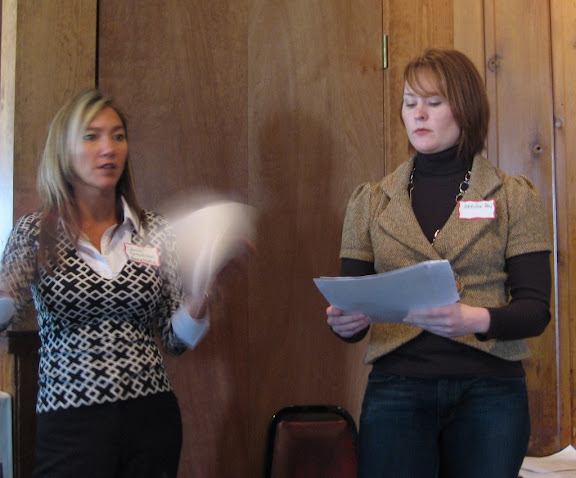 Magazine designers and editors want first rights on the use of high-resolution photographs. Obtaining the photographs for little or no charge ranks as another high priority, especially since business-to-business publications tend to have limited design budgets.
More than 30 attendees heard advice on how to come as close to that ideal situation as possible at “Dirt cheap design,” the title of a March 7 meeting of the Kansas City chapter of the American Society of Business Publication Editors held at Hayward’s Pit Bar B Que in Overland Park, Kan.
The two speakers, Jennifer Ray and Danica Tormohlen, deal with their own art budgets. They seek photography and design help inside and outside their respective companies.
Ray, senior art director with Penton Media in Overland Park, designs for American School & University magazine, which has no design budget, and Club Industry’s Fitness Business Pro magazine, which has a budget of $1,500. Besides winning two Maggies, five TOCAs and one national ASBPE award, Ray also has judged the Maggies, ASPBE and Ozzie awards.
Tormohlen works for Ascend Media Publications in Overland Park and serves as editor of EXPO Magazine, which has a design budget of $500 per month. In 2005, Tormohlen and her editorial team won the Folio; Magazine Eddie Award for Editorial Excellence and the min’s B-to-B of the Web for website redesign.
Stock up
Subscriptions to digital art Web sites have become a cost-effective way to find photos, or at least a more inexpensive way then buying compact discs, Ray said. Another option is the web.
“There are tons of different sites out there,” Ray said. “Some of them are better than others.” The art sites are set up differently. Some allow designers to pay a rate fee to download a certain number of photographs per month or per day. Some digital art websites that offer credit programs to purchase specific pieces.
A few sites worth reviewing include:
Source key
Sources are another way to find art. In her assignment letters to freelancers and full-time writers, Tormohlen tells them to ask for head shots of any or all their sources. Ray likes to work with manufacturers and sometimes asks their help in taking cover photographs. For example, John Deere has its own in-house studio and a library of images.
Both speakers said make an attempt to gain first rights to use photographs. Ray said when outside organizations like manufacturers run a photo shoot for a magazine cover, she requests that the magazine be allowed to publish the photo first before the outside organization publishes it.
EXPO Magazine reports on trade shows and conventions, which normally hire their own professional photographer and then allow publications to use the photographs for free, Tormohlen said. Convention and visitors bureaus at cities playing host to events generally have their own free images, too. Many times the images are ready to be downloaded from a website.
Picture savings
When publications can afford professional photographers, they can save money by hiring the apprentice instead of the head photographer, Ray said. Although not as experienced, the apprentice has access to the same studio and the same camera equipment. Contacting colleges also can lead to finding students who will work for a discounted rate, Ray said. Other photographers will offer a discounted rate if an agreement is reached to use them for a certain number of photo shoots per year.
Magazine cover photographs can eat up a good portion of a design budget, but they offer a great way to get a magazine noticed. Ray said she likes to perambulate through the magazine section of a book store and see which publication covers “pop out.”
Tormohlen said every other issue she tries to do a photo shoot for the cover, which can run $1,000. She selects issues where a story will lead to a good photo shoot.
“Some months we spend zero, and some months we spend $1,000,” she said. “It really depends upon the photographer we get in and where they want to have the photo shoot.”
Take it inside
Ray said her company bought a digital camera that several magazines use. Now, in-house photographers can shoot cover photographs for the two magazines she works for, she said. Publishing companies also might save money by paying for continuing education classes at area colleges, which can allow artists to pick up new skills and negate the need to contract out for such work, Ray said.
Both Ray and Tormohlen said issue reviews, which involve critiquing photographs and designs, can lead to better quality. Tormohlen said she likes to invite people outside the editorial department and art department, such as the publisher, sales representatives and circulation personnel, to a free lunch inside a conference room. There, they can spend about an hour critiquing the latest issue’s design and photography.
Friday, March 02, 2007
Apply for a Young Leaders Scholarship
The ASBPE and TABPI have begun accepting applications for the 2007 Young Leaders Scholarship. The scholarship helps B2B editors who 30 years old or younger attend the ASBPE National Editorial Conference and Awards Banquet.
This year's conference will be in New York City, Aug. 2-3. The scholarship covers the conference fees and hotel-room costs. The ASBPE selects five editors who work in the United States. Winners who are not already ASBPE members recieve one-year memberships. TABPI selects two editors from outside of the United States to attend. TABPI winners receive $500 for airfare.
I was honored to have been selected as a 2006 scholarship winner. Immediate past president of the KC chapter, Amy Fischbach, is a 2002 scholarship winner. I highly recommend young editors to apply. It's a wonderful opportunity to attend the national conference, learn from industry leaders and meet other editors from around the country -- and world.
The application deadline is May 1.
Tabbie Entries Due March 7
 You have until Wednesday to get in your submissions for this year's Tabbie awards. The awards are sponsored by Trade, Association and Business Publications International (TABPI) and cosponsored by the ASBPE.
The international awards competition is open to all English-language magazines published at least quarterly.
Click here for a PDF of the entry form.
Subscribe to:
Posts (Atom)


